Sponsored article
How Do Injection Moulding Settings and Quality Requirements Change with Bioplastics and Recycled Plastics?
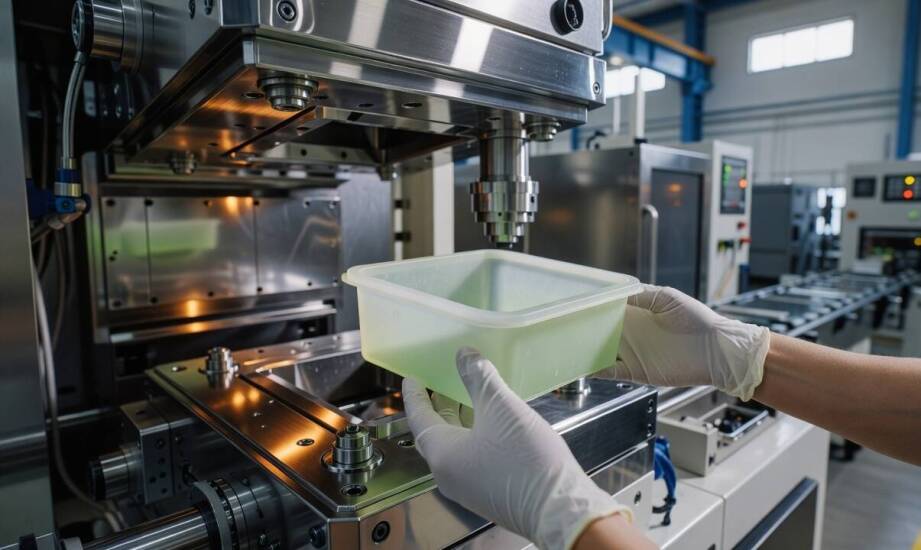
Switching from virgin polymers to bioplastics or recycled plastics requires more than simply replacing one raw material with another. Different materials can vary in moisture sensitivity, thermal stability, melt viscosity, shrinkage and batch-to-batch consistency.
Read more: How can modern entrance mats help reduce cleaning costs in large facilities?
These differences directly affect drying, barrel temperatures, injection speed, holding pressure and cooling. Stable production therefore depends on establishing a processing window for the specific grade being used rather than applying settings developed for a conventional virgin polymer.
Read more: How to Choose the Right Building Entry Mats for Sports Facilities?
Processing Parameters for Bioplastics and Recycled Plastics
Some bioplastics require particularly careful preparation before injection moulding. PLA is a good example because moisture present during melt processing can cause hydrolytic degradation and reduce molecular weight and melt viscosity.
Read more: Innovative applications of laminated packaging in the food industry
For Ingeo PLA grades, the manufacturer recommends reducing moisture to a maximum of approximately 250 ppm, although the appropriate drying temperature and residence time depend on the specific grade and whether the pellets are amorphous or crystalline.
Insufficient drying may lead to unstable processing, loss of material properties and visible surface defects.
Recycled polymers present a different challenge. Their behaviour depends strongly on the quality and origin of the recycled feedstock. Previous heat exposure, contamination, additives, mixing of different grades and storage conditions can all influence the properties of the material.
For this reason, recycled material should be qualified according to its actual specification rather than treated as one uniform category.
Why Is Processing Temperature So Important?
Processing temperature must match the thermal stability and viscosity of the selected polymer.
For PLA, there is no single universal barrel temperature suitable for every grade. Injection moulding grades can require different melt-temperature profiles, and prolonged residence at elevated temperature can accelerate degradation.
Keeping residence time under control is therefore important for maintaining melt stability and the mechanical properties of the finished part.
With recycled plastics, changes in melt flow behaviour between batches may also require adjustments to:
injection speed;
transfer point;
holding pressure;
barrel temperature;
cooling time.
The mould and cooling system must still provide stable and sufficiently uniform heat removal.
Changes in rheology can alter cavity filling, packing behaviour and final dimensional stability, which is why process monitoring becomes particularly important when the raw material itself has greater variability.
How Should the Material Be Matched to the Application?
The material should always be selected according to the requirements of the finished component rather than its environmental label alone.
Important factors include:
mechanical strength;
stiffness and impact resistance;
transparency;
chemical resistance;
operating temperature;
dimensional stability;
appearance requirements;
regulatory requirements.
A bio-based polymer is not automatically biodegradable, and a biodegradable material is not necessarily suitable for industrial composting without meeting the relevant requirements.
Likewise, recycled content does not automatically make a material appropriate for every application.
For products with strict optical or dimensional requirements, the consistency of colour, contamination level and melt properties may be particularly important. In less visually sensitive applications, selected recycled grades may provide greater flexibility in colour or surface appearance.
The material therefore needs to be assessed against the actual product specification.
What Should Be Considered When Designing the Mould?
Different materials can require different shrinkage allowances and processing conditions.
For example, one injection moulding grade of Ingeo PLA specifies mould shrinkage of around 0.4%, while many polypropylene grades exhibit higher shrinkage. The exact value, however, always depends on the grade, geometry, flow direction and processing conditions.
This means that shrinkage should be taken from the supplier’s data and confirmed during mould trials rather than assumed from the polymer family alone.
Recycled polymers may also show greater variation if their composition or processing history changes between batches.
In such cases, dimensional inspection of production samples and monitoring of process data help determine whether changes are caused by the material, mould or machine settings.
What Does Raw-Material Qualification Involve?
Qualification should establish whether a proposed polymer can meet both processing and finished-product requirements.
Depending on the project, this may include:
reviewing the technical data sheet and material specification;
checking moisture and melt-flow characteristics;
verifying recycled or bio-based content where relevant;
trial moulding;
measuring critical dimensions;
assessing visual quality;
mechanical or functional testing;
confirming production repeatability.
Noex combines plastic-product development, toolmaking and injection moulding, which allows alternative materials to be assessed in relation to both mould design and the production process.
Its ECO plastic products range includes products made using bioplastics as well as compostable, recycled and recyclable materials.
The key point is that introducing an alternative material should be treated as a technical validation project rather than a simple material substitution.
Standards, Traceability and Quality Requirements
Environmental claims and product-quality requirements should be treated separately.
For medical devices, ISO 13485 defines requirements for a quality management system specific to the medical-device sector. It does not by itself certify a polymer as suitable for medical use, nor does it automatically define sterility or bioburden limits for every product.
For recycled plastics, EN 15343 addresses traceability in plastics recycling and provides a basis for assessing recycled content.
Chain-of-custody frameworks such as ISO 22095 can also support the traceability of material characteristics through the supply chain. These standards help structure documentation and sustainability claims, but they do not replace product-specific technical testing.
The same principle applies to bioplastics. A claim such as bio-based, biodegradable or compostable should be supported by the relevant material documentation and, where required, an appropriate certification scheme.
Ultimately, the choice between virgin, bio-based and recycled polymers should be driven by the technical function of the finished component.
Alternative materials can require changes to drying, melt temperature, injection parameters, cooling and quality-control procedures. A stable and repeatable process depends on understanding the specific polymer grade and maintaining an appropriate processing window — not simply on replacing a conventional resin with a material carrying an environmental label.
Article categories
You might be interested

What are gas tanks for sale equipped with?
Gas tanks play a key role in the fuel infrastructure. This article presents the standard components installed in these tanks as well as optional accessories that enhance their functionality. This knowledge is important for people involved in the sale and distribution of gas to provide customers with

Bucket elevator as a scraping grain conveyor
A bucket elevator is an important element in grain transport, combining efficiency with reliability. In this article, we will take a closer look at its applications, benefits, and the variety of available models. Understanding the role of this grain conveyor in the grain transport process is crucial