Sponsored article
How Integrated Packaging of Tablets, Capsules, and Sachets Accelerates New Batch Launches
- Why Integrating Manufacturing and Packaging Reduces Lead Times
- Different Dosing Requirements for Tablets, Capsules, and Sachets
- Automation Systems for Seal Integrity and Process Consistency
- How Integrated Infrastructure Improves Short-Run Production Flexibility
- Operational Advantages of a Shorter Manufacturing Chain
- Key Takeaways
- FAQ
A manufacturing facility may be preparing to launch a new batch, but one of the most important decisions is made long before raw materials enter the mixers. During the planning stage, technologists determine whether the finished powder will be packed in a barrier blister, a sealed jar or a multi-layer sachet. The selected packaging format influences the physicochemical requirements of the formulation and the level of protection needed against moisture throughout the manufacturing process.
Read more: What is Vitamin K2 and What is Its Impact on the Body?
Production planners incorporate these requirements into the operational workflow, connecting ingredient preparation with the final packaging strategy. This approach helps avoid costly production interruptions and reduces the risk of semi-finished products waiting unnecessarily in intermediate storage. As a result, integrated manufacturing and packaging shorten lead times while helping maintain product stability throughout production.
Read more: What is ACR Accreditation?
Why Integrating Manufacturing and Packaging Reduces Lead Times
Combining product manufacturing and packaging within a single facility significantly reduces the number of internal transfers required between production stages. Finished products remain within a controlled environment, which reduces reliance on buffer storage areas and eliminates unnecessary internal transportation.
Read more: When Do Flat Bottom Test Tubes Make Sample Handling Easier – and When Do They Not?
Every transfer between separate contractors can add days to the production schedule due to logistics, handling procedures, and additional quality checks. In an integrated production environment, scheduling and decision-making are managed through a single operational system. Once a batch has passed required controls, it can move directly to filling or packaging lines without delays.
In the model commonly described as contract manufacturing dietary supplements, consolidating operations in one location simplifies specification management. If incoming raw materials require adjustments, process parameters can be modified immediately without disrupting the overall production flow or coordinating with external packaging providers.
Different Dosing Requirements for Tablets, Capsules, and Sachets
Each dosage form requires a different technological approach and production setup.
Tablets are created through mechanical compression of multi-component blends, which typically requires granulation and precise selection of binding and flow-enhancing excipients. Operators continuously monitor compression force, tablet hardness, and disintegration parameters throughout production.
Hard capsules are usually filled with powders or pellets without the high compression forces required for tableting. This can simplify formulation development by reducing the need for certain structural additives, although adequate powder flow characteristics remain essential.
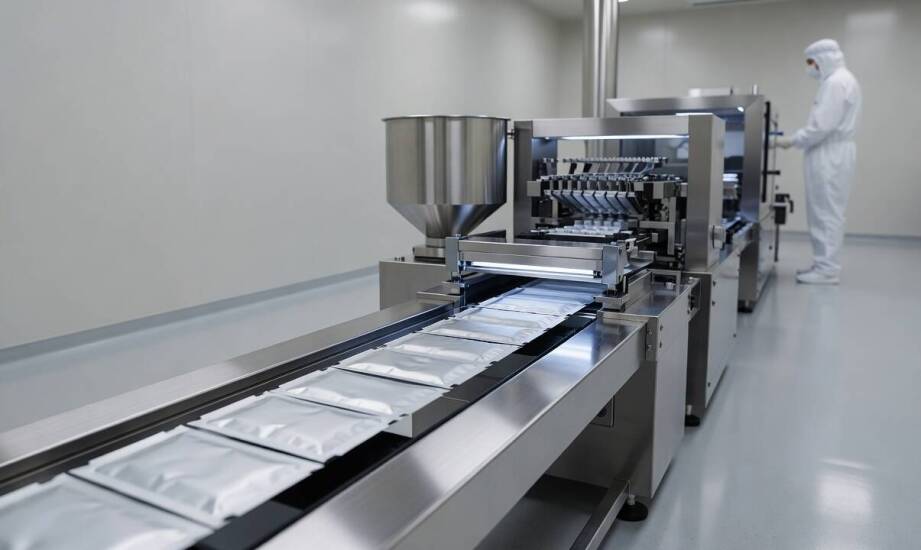
Single-dose sachets involve a completely different process. In their case, powder dosing occurs simultaneously with the formation and thermal sealing of the packaging material. Managing these three distinct manufacturing routes under one roof often requires infrastructure capable of maintaining different environmental conditions for individual production lines.
Automation Systems for Seal Integrity and Process Consistency
Modern production facilities rely on sensor-based automation systems that correct minor deviations without interrupting operations.
Automated dosing systems used in high-speed capsule filling and tableting equipment maintain consistent fill weights and automatically reject units that fall outside established weight specifications. During sachet packaging, one of the key priorities is verifying seal strength and package integrity.
Precision auger fillers and advanced packaging drives help create sealed barriers that protect active ingredients from environmental exposure. Integrated blister packaging systems connected directly to cartoning lines streamline cavity forming, product loading, and carton assembly.
Advanced vision inspection systems and SCADA-based process monitoring record sealing temperatures, equipment settings, and process parameters in real time, supporting traceability and facilitating final quality release procedures.
How Integrated Infrastructure Improves Short-Run Production Flexibility
Managing varying production volumes efficiently requires flexibility, and fragmented supply chains often increase preparation costs.
Concentrating production and packaging equipment within a single facility simplifies the execution of short production campaigns where packaging formats change frequently. Engineering optimization measures standardise and reduce equipment changeover times across manufacturing and packaging modules.
EuroPharma Alliance utilises integrated production and packaging infrastructure that supports transitions between different product specifications without unnecessary downtime. Technical teams can quickly replace tooling and dosing components, minimising production interruptions.
Eliminating the need to transport large quantities of semi-finished products between separate locations also helps reduce material losses during handling. Smooth transitions between formulations support scheduling efficiency, particularly during periods of increased market demand.
Organisations that perform manufacturing and packaging internally retain greater planning flexibility and can adapt production resources more effectively to changing requirements.
Operational Advantages of a Shorter Manufacturing Chain
A closed operational model that combines formulation processing and final packaging can be particularly beneficial when product portfolios change frequently or when packaging requires advanced barrier properties.
A shorter material flow path helps protect sensitive ingredients from prolonged exposure to variable environmental conditions while awaiting subsequent processing stages. Fewer organizations involved in production simplify traceability, quality oversight, and cost management.
Customers benefit from working with a single engineering and operational team rather than coordinating audits across multiple facilities. Bringing technical expertise and packaging resources together within one organization can also improve the handling of complex laminate structures and specialized packaging materials.
Reducing the distance between ingredient processing and final cartoning minimises documentation risks and streamlines movement of finished goods to shipment-ready pallets.
Key Takeaways
The choice of packaging format influences batch requirements long before production begins.
Combining manufacturing and packaging reduces internal transfers and shortens overall lead times.
Tablets, capsules, and sachets require different dosing, processing, and packaging approaches.
Automation supports consistency, package integrity, and continuous monitoring of fill weights and seals.
Integrated operations simplify short production runs, accelerate changeovers, and reduce downtime.
The greatest benefits are achieved when managing variable orders, complex packaging formats, and demanding quality requirements.
FAQ
Why is packaging determined during the planning stage?
Packaging requirements affect the entire manufacturing process because they influence moisture protection, product stability, and packaging methods. These factors determine process settings and production organisation from the beginning, helping prevent delays and costly rework later in the project.
What are the main differences between packaging tablets, capsules, and sachets?
The primary differences relate to dosing methods and packaging requirements. Tablets are typically compressed and then packaged in blisters or jars. Capsules require suitable powder-flow characteristics, while sachets combine filling and package formation in one process. Each format also requires different approaches to seal integrity and quality control.
When does integrated packaging offer the greatest operational advantage?
Integrated packaging delivers the greatest value during short production runs, frequent portfolio changes, and projects involving complex packaging formats. It reduces changeover times, limits downtime, and decreases product handling between stages while supporting tighter batch control.
Article categories
You might be interested

English translation of intellectual property legal advice
Corporate law plays a key role in driving innovation and the development of technology start-ups. Adequate regulation enables entrepreneurs to focus on creating cutting-edge solutions. In addition, they support collaboration with others and the raising of finance, which is essential for success in a

When Do Flat Bottom Test Tubes Make Sample Handling Easier – and When Do They Not?
In everyday laboratory work, samples are repeatedly transferred, dosed, inspected and moved between workstations.Read more: What is Vitamin K2 and What is Its Impact on the Body?Sometimes a seemingly small feature of a laboratory vessel can affect the ergonomics of the entire procedure.Read more: Wh